Sales Surface: Reimagining the AI-Native Workspace Beyond Chat
Project Timeline: 2026 (Ongoing)
Co-Designer | AI Interaction Design and Prototyping
Chat-first AI interfaces ask people to compose a request from scratch every time, even for the questions they ask every day. With a colleague, I designed and built a working prototype that reimagines an AI-powered workspace around the way reps already think: proactive surfacing and one-click actions first, chat available but never the entry point.
My Role
Co-designed the interaction model with a colleague, applying our Show vs. Ask framework — determining when the system should proactively surface information versus wait to be asked — at both the portfolio level and the individual account level. Built the working prototype and led the information architecture: what surfaces automatically, what requires a click, and where chat fits as a fallback rather than a front door.
Business Opportunity
A sales rep managing a book of dozens of accounts doesn't want to type "which of my accounts need attention today" every morning — they want to open a tool and already know. Chat-first AI products treat every interaction as a fresh conversation, which works for novel questions but adds unnecessary friction to the predictable, recurring ones that make up most of a rep's day. We set out to test whether structuring an AI product around anticipated needs, rather than an empty prompt box, could meaningfully lower that cost.
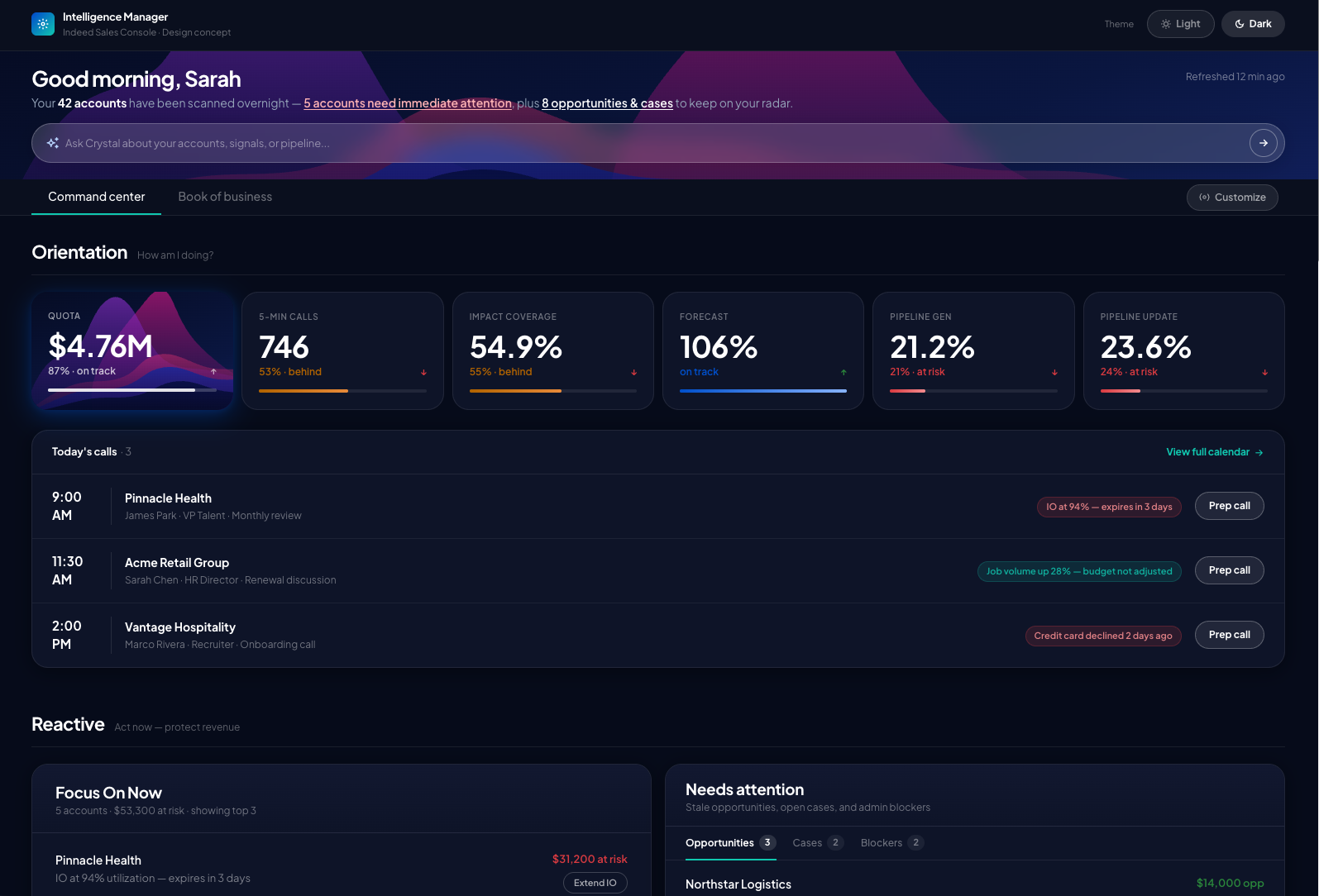
Sales surface prototype in React: What if we could re-imagine the main interface and interaction of AI powered tools? What if we could harness the power of an LLM and offer an intelligent, role specific tool that they could use to understand their current priorities, analyze account performance and generate collateral for client outreach?
Impact At-A-Glance
✓ Built as a sanctioned Indeed exploration, testing whether an AI-native workspace beyond chat measurably lowers the effort of getting value from an LLM
✓ Applied proactive surfacing at two levels: portfolio-wide (book health, at-risk accounts, today's priority) and account-specific (renewal status, engagement signals, recommended next move)
✓ Structured chat as a secondary panel with pre-populated likely questions, not a blank prompt — present, but never the required entry point
✓ Reduced common recurring tasks (drafting outreach, scheduling a quarterly business review, extending an insertion order) to single-click actions surfaced in context, rather than requests a rep has to compose
Strategic Challenge
Starting Assumption
Reps needed a better CRM interface — cleaner layout, fewer clicks, faster access to what they already look for.
Reality
Research surfaced a different, more fundamental constraint:
1. The platform itself was the ceiling
No redesign of the existing CRM interface could give reps the synthesized, cross-account visibility they needed — the platform's own architecture wasn't built to support it.
2. Reps' actual jobs extended beyond CRM data
Meeting prep, presentation building, and account synthesis routinely required pulling in outside documents and spreadsheets that had no home inside the CRM at all.
3. Analysis and outputs were manual and inconsistent
Recurring outputs like call prep or account health summaries were built from scratch each time, with quality depending entirely on the individual rep's time and effort that day.
Strategic Bet
Rather than proposing another CRM interface redesign, we reframed the work as building a new layer on top of the underlying data:
Query the database directly, not through the CRM's own interface constraints — unlocking views the platform was never designed to surface
Extend the workspace beyond CRM data, letting reps bring their own documents and spreadsheets into the same environment
Turn recurring work into reusable skills — meeting prep and presentation generation as consistent, repeatable outputs rather than one-off manual effort each time
Account Detail view: The sources on the side, the recommended outputs and suggested prompts all update according to the page the rep is currently looking at.
How Our Surface Behaves
-
When the book summary flags an account, the reasoning is laid out alongside it, and recommended actions sit next to the reasoning that produced them, so a rep can judge a suggestion before acting on it.
-
Sources, recommended outputs, and suggested prompts all update to match the page the rep is on. The pre-populated questions in the chat panel come from that context, not a generic list, so even the fallback is specific.
-
On an account, a three-part summary shows what changed, what's true right now, and what to do next. on text goes here
Process, Decisions, Solutions
Activities
JTBD-grounded diagnosis — used existing jobs-to-be-done mapping to identify where reps' real work was going unmet by the CRM interface itself, not just its usability
Rapid prototyping with Claude and Cursor — built a working interface directly rather than static mockups, allowing the interaction model to be tested as a real product, not a concept deck
Direct database integration — queried Salesforce's underlying data rather than working within the CRM's own interface constraints
Skill design for recurring outputs — built reusable skills (meeting prep, presentation drafts) so common, repeatable tasks produce consistent results instead of being rebuilt from scratch each time
Process
We started from JTBD mapping already in progress across the sales organization, using it to identify where reps' real jobs were unmet by the existing CRM interface. From there, we prototyped rapidly using Claude and Cursor — moving from concept to a working, clickable interface fast enough to test the underlying hypothesis directly rather than debate it in the abstract. The result surfaces book-level and account-level information automatically, lets reps bring in their own source material, and packages recurring tasks into repeatable skills.
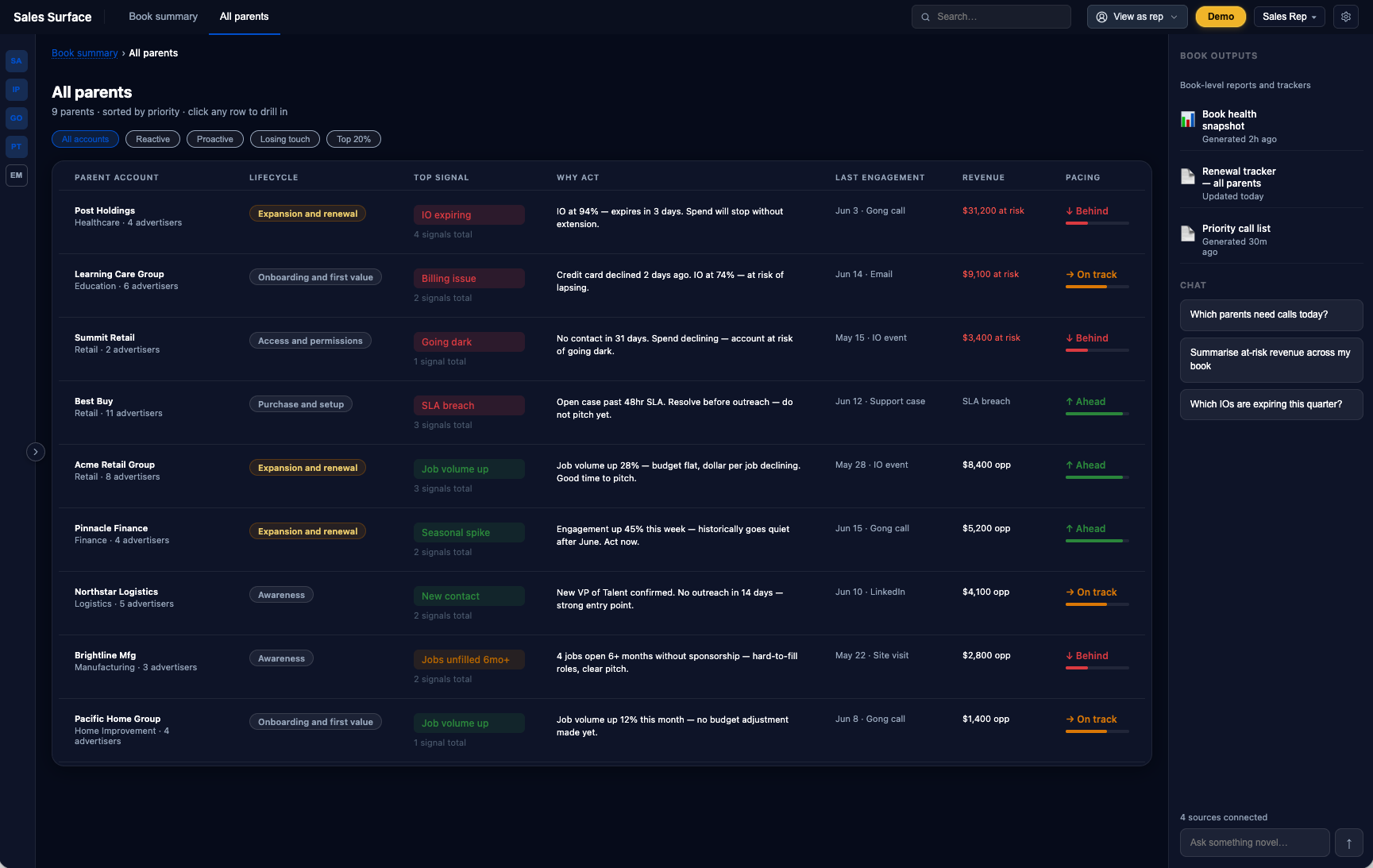
Book of Business View: Another view reps can use to get a full understanding of all of their clients and how they stack up against each other. Note how the outputs and recommended chat prompts update depending on which screen the user is viewing.
One of our research findings: customization and personalization is essential to encouraging trust in the technology
-
The insight that unlocked this project: the CRM's data was fine, its interface was the constraint. Building a new layer on the underlying database, rather than redesigning the existing screens, is what made synthesized cross-account views possible at all.
-
Chat is present in every view as a secondary panel, pre-loaded with likely questions, not an empty box demanding composition — most of what a rep needs is either already surfaced or one click away.
-
Meeting prep and presentation generation are built as skills that produce consistent output every time, not manual work redone from scratch by each rep for each account.
With the help of AI, we can tailor the interfaces to be hyper-specific to what matters most to our specific users. In this example, our sales reps were primarily concerned with meeting their quota and meeting their impact coverage metrics. This design offers recommended accounts and actions they can take to achieve both.
Lessons Learned
-
The prototype doesn't yet give reps a way to flag a wrong recommendation or tell the system why. For now, the safeguard is visibility: every recommendation shows the reasoning behind it, so a rep can judge it before acting. Designing the feedback loop is the next piece of work for the next phase.
-
Reps rely on spreadsheets and documents they've built themselves, and they trust them more than any system view. Rather than trying to replace those assets, we built the workspace to use them as sources and help reps keep them current. That decision reshaped the product strategy, and it was the turning point in how reps responded to the prototype during testing.
Business Outcomes
✓ Reframed a surface-level CRM complaint into a platform-limitations diagnosis grounded in research, not assumption
✓ Delivered a working prototype, built through rapid AI-assisted prototyping, that Indeed sanctioned as an active exploration
✓ Demonstrated that querying underlying data directly — rather than redesigning existing CRM screens — was the real unlock
✓ Extended the tool's value beyond CRM data by letting reps bring their own documents and spreadsheets into one workspace
✓ Applied the Show vs. Ask framework end-to-end in a working product, including skill-based automation of recurring tasks