Proactive AI for Enterprise Sales: Designing Intelligence-Driven Engagement
Project Timeline: 2025–2026
Sr. UX Designer | Lead Designer
AI Interaction Design | Enterprise CRM | Agentic Workflows
Business Challenge
Indeed's marketing organization processes over 1.5 billion customer touchpoints monthly — but sales and CS reps had no reliable way to know which signals actually mattered. Generic outreach, missed high-intent moments, and relationship blind spots were costing revenue. The challenge wasn't a lack of data. It was the absence of an intelligence layer that could separate signal from noise and surface the right information at the right moment — without adding cognitive load to an already overwhelming workflow.
My Role
Lead designer responsible for the full interaction model — defining how AI-generated intelligence should be surfaced, structured, and acted upon within the existing Salesforce workflow. Designed the Show vs. Ask architecture, the signal transparency layer, the AI-pre-populated action flows, and the relationship between proactive intelligence and conversational AI access.
Impact At A Glance
✓ Designed the Show vs. Ask interaction model — proactively surfacing prioritized, contextualized account intelligence before reps ask, with conversational AI available as a secondary layer for novel queries
✓ Eliminated the signal-to-noise problem — multi-touch attribution model correlating engagement across 1.5 billion monthly touchpoints into single prioritized recommended actions per account
✓ Built explainability into the interaction model — every AI recommendation surfaces the signals that generated it, giving reps the context to act confidently and override when needed
✓ Designed AI-assisted action flows — opportunity creation pre-populated from account signals, reducing manual data entry while keeping humans in control of final decisions
✓ Selected for presentation to Indeed's global revenue leadership at the March 2026 Global Leadership Meeting
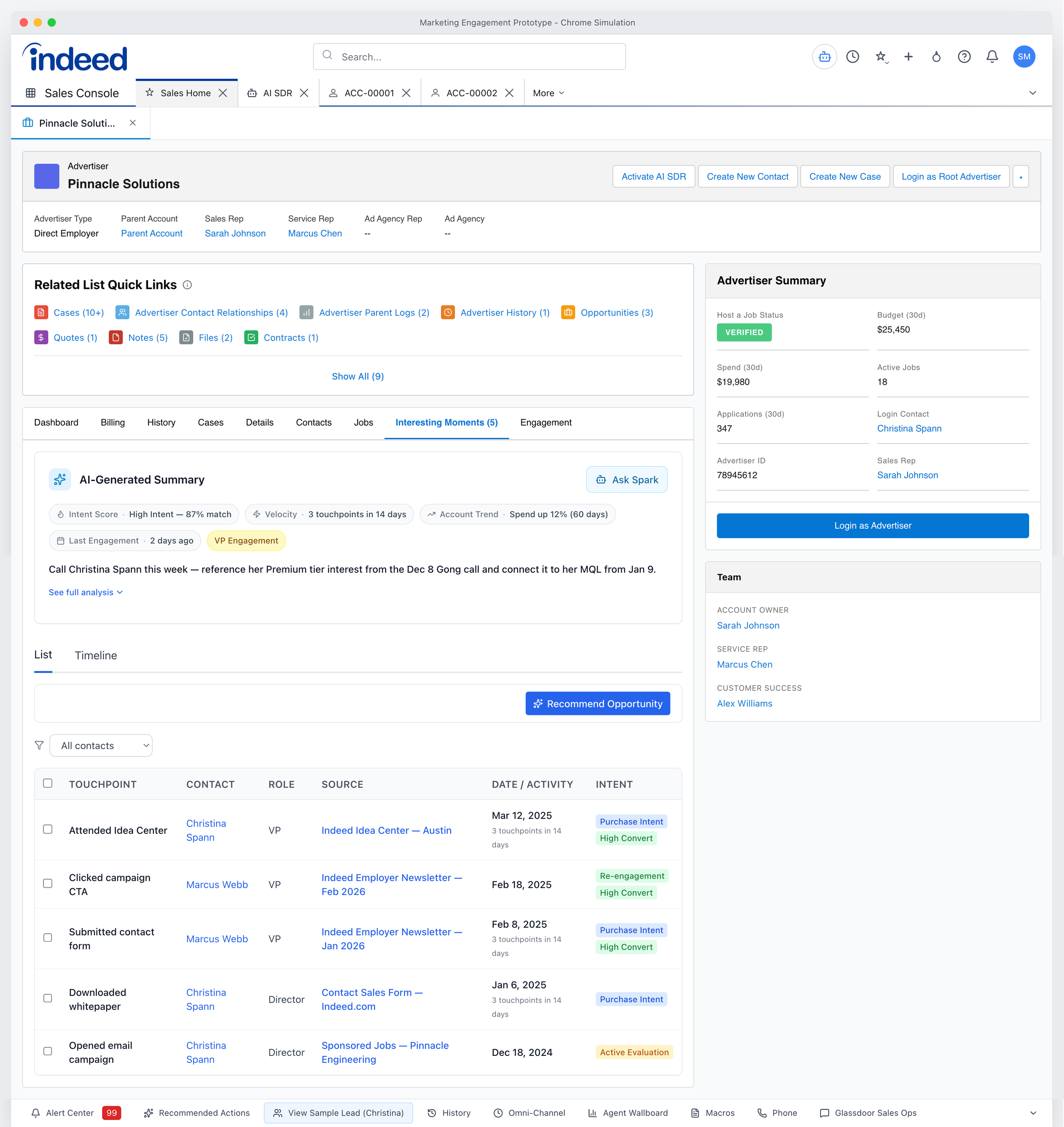
The Marketing Interesting Moments tab surfaces an AI-generated summary at the top of the account page — intent score, velocity, account trend, and a single prioritized recommended action. The full signal list below shows every touchpoint that informed the summary.
Strategic Challenge
The Trigger: Sales reps were missing high-intent signals not because the data didn't exist, but because it was distributed across systems with no synthesis layer. A VP-level contact attending an event, downloading a whitepaper, and clicking a campaign CTA within 14 days — individually, each signal is noise. Together, they're a buying signal. No existing tool was connecting those dots.
The Real Challenge: Intelligence without cognitive load
Building an AI signal layer inside an existing CRM workflow created three distinct design problems:
Prioritization: With thousands of accounts and millions of signals, how do you surface the one thing a rep should act on today — without overwhelming them with everything that might matter?
Explainability: Reps won't act on AI recommendations they don't trust. How do you show your work without burying the insight?
Human-in-the-loop: AI can identify the opportunity. Only the rep can decide whether to act. How do you design for confident human override without undermining the value of the recommendation?
The Strategic Frame: This wasn't a notifications feature. It was an intelligence layer — the difference between a system that stores data and a system that encodes expertise and surfaces it proactively.
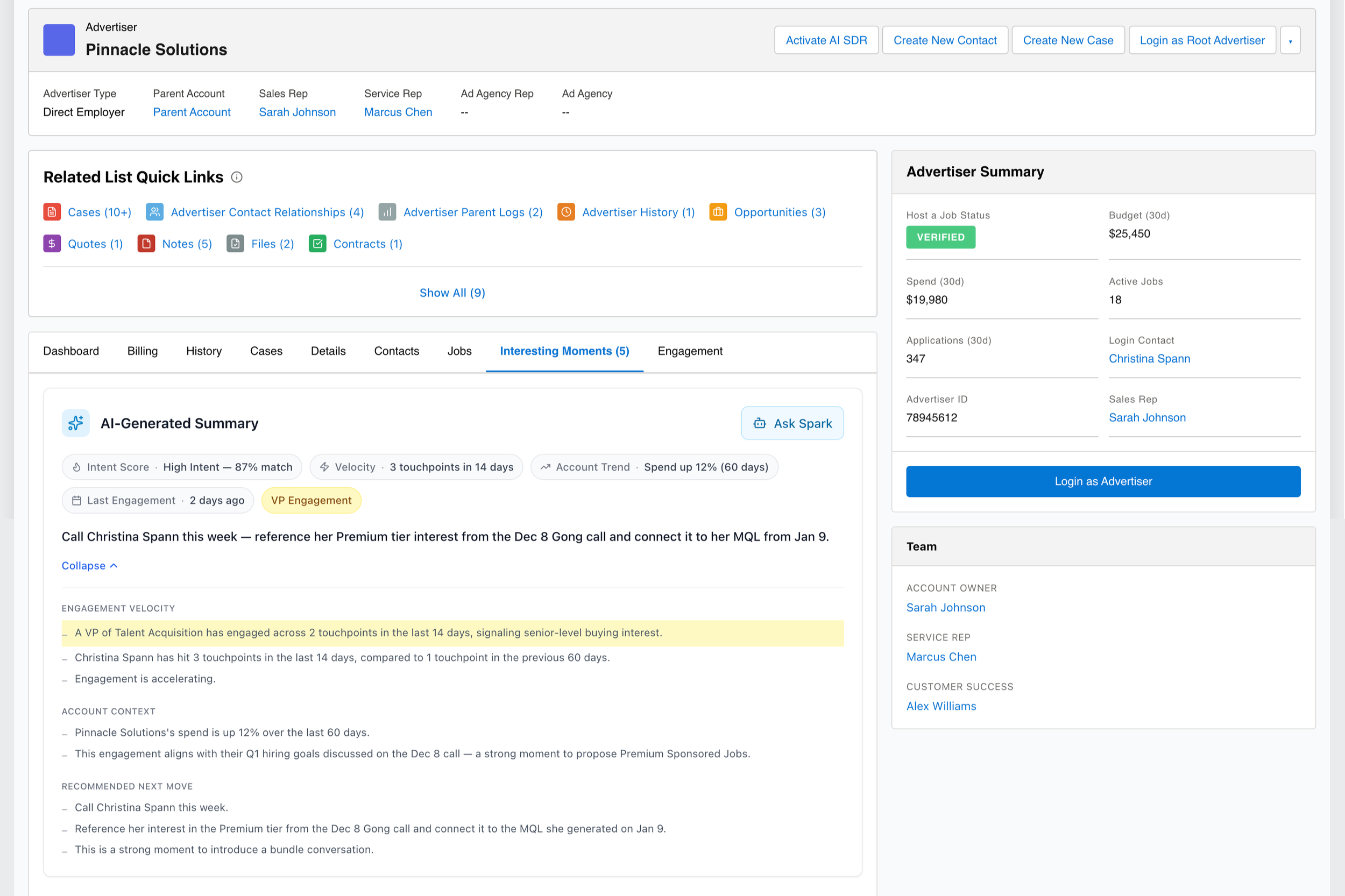
Expanding "See full analysis" reveals engagement velocity, account context grounded in conversation history, and specific recommended next moves — all before the rep has typed a single query.
PROCESS:
I approached this as a Show vs. Ask design problem — the question wasn't how to add AI to the account page, but how to define the right role for proactive intelligence versus conversational interaction within a single workflow.
Phase 1: Signal Architecture — Worked with product and data science to understand which signals could be reliably correlated and how propensity scoring would prioritize them
Phase 2: Show vs. Ask Framework Application — Mapped which account intelligence could be anticipated and surfaced proactively versus which queries required conversational interaction
Phase 3: Explainability Design — Designed the signal transparency layer showing reps exactly what touchpoints informed each AI summary
Phase 4: Action Flow Design — Designed AI-assisted opportunity creation, pre-populating fields from account signals while preserving rep control over final decisions
Phase 5: Prototype & Validation — Built and iterated full-fidelity prototype, presented to VP-level and global leadership for alignment
Proactive Context vs. Blank Chatbot: The Agentforce panel surfaces relationship context and pre-populated conversational prompts — making the Ask layer accessible without competing with the proactive Show layer.
Key Decisions
-
The AI-generated summary leads with a single prioritized action — "Call Christina Spann this week, reference her Premium tier interest from the Dec 8 Gong call." The supporting evidence — engagement velocity, account context, signal list — is available one tap away but doesn't compete for attention with the recommendation itself. Reps who trust the system act immediately. Reps who want to verify can dig deeper without friction.
-
Every AI summary surfaces the specific touchpoints that generated it — who engaged, when, through which channel, and with what intent classification. This isn't just transparency for its own sake. It gives reps the context to personalize their outreach and the confidence to override the recommendation when their relationship knowledge contradicts the signal data.
-
The "Recommend Opportunity" flow pre-populates an opportunity record from account signals — suggested products, amount, probability, close date — but presents it as editable fields, not a completed action. AI does the administrative work. The rep makes the call. This human-in-the-loop design was deliberate: reps need to own the decisions that affect their pipeline.
-
"Ask Spark" is present but not foregrounded. Suggested questions in the Agentforce panel — "What's changed since the last call?" "Has CS had any recent contact?" — surface the kinds of novel, cross-object queries that proactive intelligence can't pre-answer. The architecture is explicit: Show handles the predictable 80%, Ask handles the rest.
Giving The User Control: When a rep acts on a recommendation, the opportunity record is pre-populated from account signals — suggested products, amount, and probability calculated from engagement data. Fields remain fully editable, keeping the rep in control of the final decision.
Results
✓ Delivered a working interaction model for proactive AI intelligence inside enterprise sales workflows — moving beyond chatbot-first AI design toward context-aware, workflow-embedded intelligence
✓ Solved the explainability problem — every AI recommendation is grounded in visible, verifiable signal data, giving reps the confidence to act or override
✓ Reduced time-to-action on high-intent accounts by surfacing prioritized recommendations before reps need to search for them
✓ Demonstrated that AI-assisted action flows can preserve human agency — pre-populated but editable opportunity creation reduces admin burden without removing rep judgment from consequential decisions
✓ Selected for GLM presentation to Indeed's global revenue leadership, validating the interaction model as a strategic direction for the GTM organization